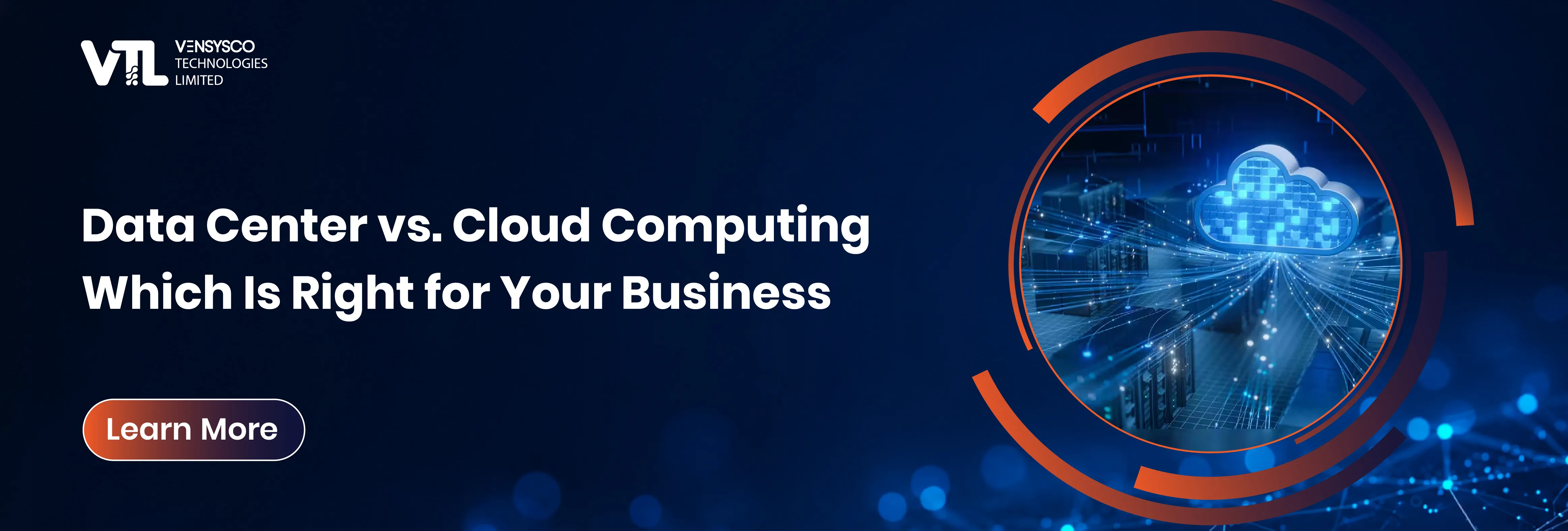
Data Center vs. Cloud Computing: Which Is Right for Your Business
11-11-2026
Every business depends on reliable technology, but the implementation of technology depends on how it is hosted and what that host means to the business in terms of cost, performance, security, and growth. There are servers for some organizations, and there are cloud servers for others. With a data center vs. cloud computing comparison, the decision will lie with your current operations, workloads, budget, and plans.
One good way to begin is to determine which systems are critical to the operation of the day, how much downtime is tolerable, and if demand is consistent year-round. These details, in the real world of business, make the comparison more practical than technical.
What Actually Is a Data Center?
A data center is a business that houses electronic equipment, such as servers, storage devices, networking components, power systems, and cooling systems. It is used by businesses to execute app and keep information. A company can have its own facility, lease space in a Data Center or sign up for Data Center Services.
In a traditional Data Center Infrastructure (DCI), the organisation owns and manages the hardware, configurations, access and maintenance. This is good for workloads that need performance or compliance, but equipment, maintenance and upgrades will cost money.
Cloud Computing: What is it?
Cloud computing services are services that give us computing power, storage, databases and other IT resources over the internet. A business does not have to buy all of the servers in a single large order, but can instead lease resources from a provider and scale them up or down as needed. Cloud computing solutions are available for websites, business applications, analytics, backups, development and remote teams.
Customers are responsible for applications, permissions, data protection and usage, while the management of physical equipment is reduced by the use of Cloud Infrastructure Services. This flexibility is helpful in times of changing demand.
Data Center vs Cloud: What's the Difference?
The primary differences lie in ownership, management, scalability and payment.
Control: On-premises infrastructure provides the organisation with control over hardware and configurations. While there are a number of configuration options available on cloud platforms, customers operate in the service and policy space of the provider.
Scalability: If the data center needs to grow, it might need equipment purchases and installations. Cloud resources can be added and removed more quickly (but not due to architectural or technical limitations).
Maintenance: Hardware maintenance, power and cooling management, monitoring, replacement planning are all a part of maintaining a data center. Cloud providers are responsible for physical facilities, but the customer owns applications, permissions and data governance.
Delay in deployment: It may take time to get new data center equipment. Cloud services can frequently be provisioned in a very short amount of time, and this will enable groups to test the ideas and release software earlier.
The Monthly Bill: Data Center vs Cloud Costs
When it comes to costs, it is important to note that there is no direct comparison between server prices and cloud subscriptions. Data center costs consist of hardware, networking, electricity, cooling, space, employees, security, and upgrades.
Cloud costs include usage, storage, data transfer, and support costs. While cloud storage solutions can decrease the use of local hardware, unused resources and transfer costs can lead to higher bills. Consider the long-term expenses such as staffing, backups, downtime, and migration.
Owned or colocated infrastructure may prove to be financially appealing for predictable workloads, processes that run around the clock. Cloud can provide more flexibility for shifting demand, rapid growth, or for short-term projects. Don't presume one model is always cheaper; examine actual loads.
Compliance and Business Continuity, Security
Security is dependent on controls, not location of the server. The business is responsible for physically monitoring, patching, backing up and restoring data in a company-managed data center. Data Center Hosting Services can include facility duties, but application and data can be separated into ownership.
Cloud providers provide identity management, encryption, logging and backup, but these tools need to be properly set up. Applications still need to be secured and access managed by businesses. Indian organisations must carefully consider them before transferring sensitive data.
Test backups, recovery procedures and monitoring are needed in both models to minimize disruption.
How to know when to use Cloud Computing for businesses?
Cloud is an option for businesses that require rapid application deployment, distributed teams, adapting to fluctuating traffic and trial of digital services. Modernisation without the need for new physical capacity for each modernisation project can be achieved with the help of a firm called Enterprise Cloud Solutions. Assessment, planning, workload migration, testing and optimisation can be supported by cloud migration services, minimizing disruption during the transition.
Often it is not necessary to move everything at once. Before migration, consider application dependencies, data volume, compliance, costs and staff readiness.
When Does a Data Center Make More Sense?
For organisations requiring specific hardware, consistent, high utilisation, direct control or equipment that can't be transported, a data center can be the right fit.
It is not always an either-or scenario between Data Center and Cloud. Many companies are running both some workloads on-premises and others in the cloud—for redundancy, development, analytics, or as front-line applications.
Why Hybrid Cloud Solutions Are Gaining Attention?
Hybrid cloud solutions are a combination of on-premises or private infrastructure and public cloud services. Workloads can be deployed based on performance, security, cost and operational needs. For instance, sensitive systems can be kept in a controlled environment, while scalable applications can utilize cloud resources during peak times.
Hybrid enables a gradual transition to the modern, but demands secure connectivity, consistent security and monitoring and cost visibility.
How to make the decision at the right time?
First, identify applications and determine the business criticality, performance requirements, level of data sensitivity, application usage, and recovery requirements. Estimate the total cost of running each workload in a data center and in the cloud. Next, review the abilities of the team, career paths, security requirements, and downtime.
For some organisations, it's time for a new data centre for others, it's cloud-first or hybrid. Review the decision as priorities change.
The end result isn't to pick the latest thing; it's to create a sturdy base that helps your people and your customers. Considering data center vs cloud computing carefully will enable your business to make informed investments, increase resilience, and get ready for the future.
Ready to secure your next examination?
Contact Vensysco today to learn how AI surveillance can safeguard your assessments.
Schedule a Demo