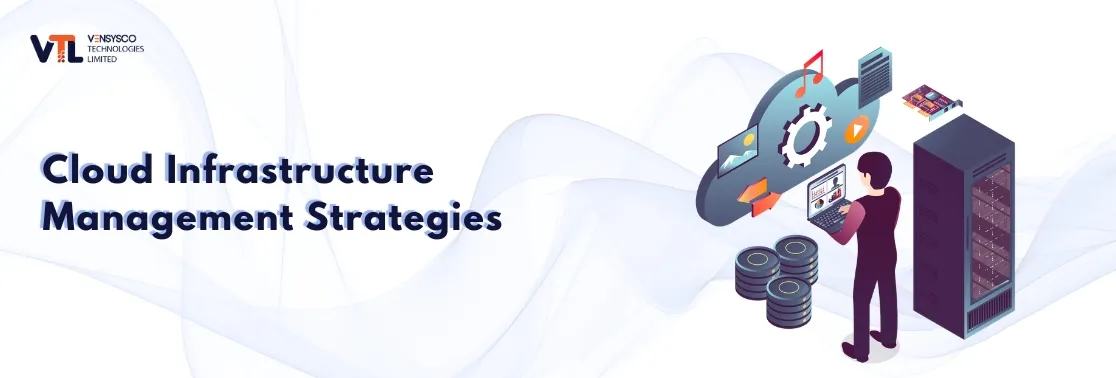
Cloud Infrastructure Management Strategies for Enterprise Growth
13-05-2026
Contemporary businesses must adapt and develop scalable solutions to cope with the rapidly evolving digital landscape. Traditionally designed hosting environments do not have enough scalability and flexibility to handle emerging business requirements. With the growing reliance on digital technologies, cloud-based infrastructure management solutions have become increasingly important within modern enterprises.
Cloud infrastructure management aims at achieving secure, scalable, and reliable environments within distributed systems. Cloud infrastructure solutions include such elements as computing resources, storage, network, applications, and operational processes. The main goal is to create a scalable, sustainable, and efficient environment for future business success.
Scalability Through Intelligent Resource Management
The capability of cloud infrastructure to dynamically scale resources based upon fluctuating user demand represents one of the advantages to cloud computing. Enterprises do not have to keep their fixed-capacity physical servers, which may not cope well when demand is high. Likewise, enterprises do not incur any unnecessary costs arising from inefficient utilization of their infrastructure due to reduced demand.
Auto-scaling dynamically allocates compute capacity based on demand in the cloud environment. When demand is high, more computing power can be assigned to ensure optimal performance. Once demand decreases, excess resources can be deprovisioned to reduce unnecessary infrastructure costs.
Elasticity is especially important for e-commerce platforms, SaaS applications, financial service providers, and streaming platforms, where workload demand changes frequently. Organizations can maintain high performance without the need to invest large sums in physical server infrastructure.
Enterprise scalability is commonly achieved through a combination of horizontal and vertical scaling strategies. Horizontal scaling moves workloads to multiple instances of servers, while vertical scaling increases the processing power of an existing server. Combining horizontal and vertical scaling strategies helps organizations build flexible infrastructures capable of supporting long-term workload growth.
Infrastructure Visibility and Operational Control
As hybrid and multi-cloud environments expand, centralized monitoring and governance become more important. Limited infrastructure visibility can result in inefficient resource allocation, application slowdowns, and higher operational risks.
Modern monitoring platforms deliver real-time insight into several crucial performance metrics, such as CPU, memory, network utilization, storage input/output operations, and application availability, enabling IT teams to identify and resolve any infrastructure problems before affecting the end-user experience.
Centralized observability also improves troubleshooting by helping operations teams identify the root causes of performance issues more efficiently. For example, sudden increases in application latency may indicate database bottlenecks, storage limitations, or network congestion. Earlier issue detection reduces downtime and improves overall service reliability.
A good cloud governance model will ensure consistency in operations within an organization by ensuring effective access control, isolation of workloads, monitoring of compliance issues, and proper data handling processes. The key features in a governance model may include identity and access management (IAM), workload labeling and isolation, regulatory compliance, and data placement.
Some industries that are highly regulated and need to follow many policies, regulations, and guidelines include health care, financial services, and insurance companies. These organizations need to use cloud governance models that ensure that they are fully compliant with policies such as GDPR, HIPAA, and PCI-DSS.
Performance Optimization in Cloud Environments
System performance directly impacts user experience, operational efficiency, and business growth. Slow-loading applications, service disruptions, and high latency can negatively impact customer engagement and revenue generation.
Proper workload management and well-designed cloud architecture ensure consistent performance of applications during different traffic scenarios. Load balancing is a strong example of application performance optimization because it distributes traffic evenly across servers and prevents overload conditions.
CDNs improve content delivery speeds by caching static assets closer to end users across distributed edge locations. Edge computing further reduces latency by processing data closer to regional users instead of relying entirely on centralized data centers.
Optimizing databases is another important step to maintaining performance. Managed databases, read replicas, caching layers, and distributed storage systems help improve throughput while maintaining data consistency across applications.
One such architecture that has gained prominence as an alternative to monoliths in software engineering is the microservices architecture. The key advantage with microservices architecture is that it facilitates breaking down the application into small modules which can then be individually scaled depending on the requirements.
Automation and Infrastructure Efficiency
It is becoming increasingly inefficient to manage large-scale cloud environments manually as infrastructure complexities increase. On the other hand, automation allows businesses to manage huge infrastructures better compared to previous levels of inefficiency while decreasing their operational complexities.
Automation of infrastructures entails using templates, scripts, and preconfigured settings to ensure consistency within the infrastructure through all environments, including development, testing, and production environments. Consequently, standardization of environments makes it easier to eliminate inconsistencies within environments.
CI/CD automation enables organizations to deliver applications faster while improving deployment consistency and reliability. Automated patch management helps keep systems updated against known vulnerabilities.
Self-healing infrastructure systems can recover from unexpected failures by restarting affected services or containers automatically.
The workloads can also be automatically shifted, and failover systems triggered without any need for human action.
By eliminating mundane administrative processes, the infrastructure management team is then free to focus on improving the system.
Security and Data Protection
Security is a crucial aspect in any organization that uses cloud infrastructure. There will be a range of security challenges associated with the cloud environment that an organization will have to contend with including identity theft, API exposure, ransomware, and misconfiguration.
There are Identity and Access Management (IAM) solutions available that mitigate security risks through the use of a least privilege approach whereby individuals are given access to only the resources required for their roles. IAM solutions assist in strengthening the process of identifying and authenticating users by enforcing multi-factor authentication (MFA).
Encryption and real-time monitoring technologies help organizations strengthen cloud security by protecting sensitive data and identifying potential threats. AES-256 and TLS technologies would prove useful here.
Real-time security monitoring provides the ability for organizations to identify potentially suspicious behaviours and cyber threats. The application of SIEM platforms allows for the aggregation of logs from the IT infrastructure and provide insight into any types of suspicious activities such as unauthorized access and irregularities in network traffic.
The ability of an organization to effectively respond to a cyber threat or data loss is closely connected to the data backup and disaster recovery processes that they have established. This is supported through the creation of non-rewriteable backups with geo-redundant replication as well as automation of recovery methods.
Business Continuity and Future Readiness
The Cloud Infrastructure Management solution now becomes one of the integral elements for business scaling and agility, as well as digital transformation initiatives.
An efficient cloud infrastructure management strategy would guarantee that the organization has the capability to scale and develop as an enterprise through creating new services, providing remote assistance, improving the performance of applications, and innovating. In addition, such enterprises will be able to reduce the risks and ensure environmental sustainability for their infrastructures.
Considering the fact that the technologies such as artificial intelligence, edge computing, automation, and even distributed cloud computing are growing rapidly, it is predicted that the Cloud Infrastructure Management solution will still remain essential for further growth of businesses.
Firms that implement scalable, reliable, and high-performance cloud infrastructures are better positioned for future growth.
Businesses looking to improve scalability, flexibility, and performance can also explore modern cloudhosting strategies for better infrastructure management and long-term operational efficiency.




Ready to secure your next examination?
Contact Vensysco today to learn how AI surveillance can safeguard your assessments.
Schedule a Demo