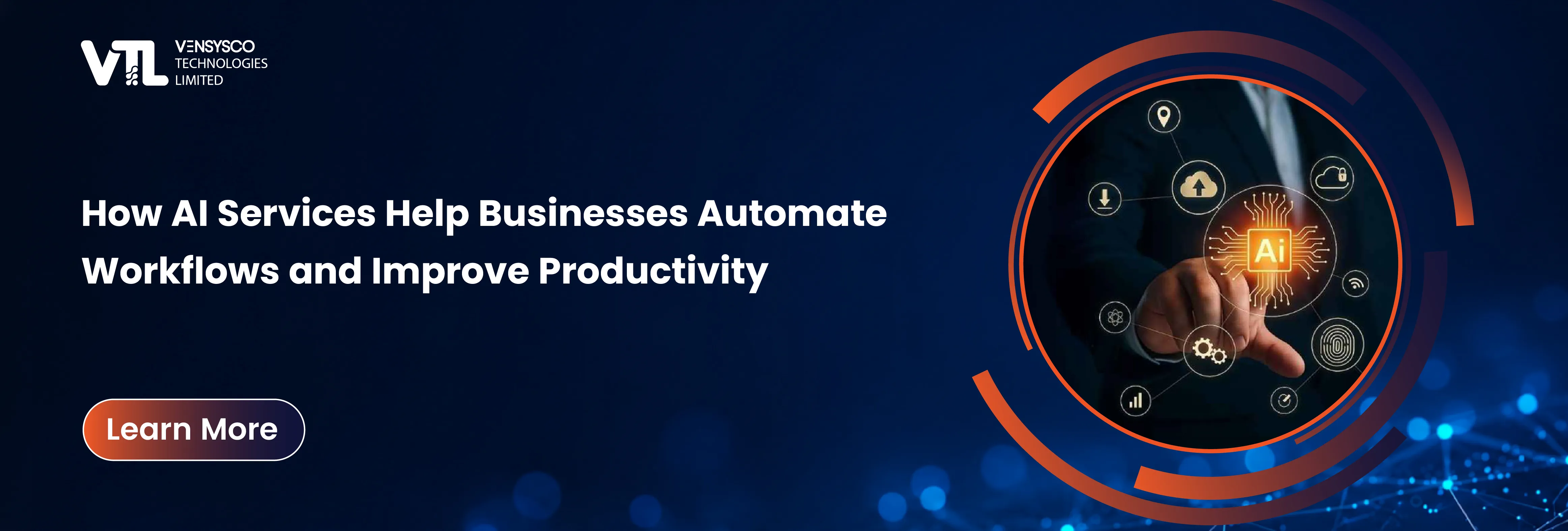
How AI Services Help Businesses Automate Workflows and Improve Productivity
03-10-2026
AI Services are designed for helping businesses automate processes and boost productivity. AI services aim to help businesses streamline and improve productivity.
In the past, AI was seen by businesses as a content or question generator, but today, it is used for other purposes. The bigger opportunity is in the background; when AI can digest information, make decisions, move information from one system to another, and help teams to take automated action on routine workflows. That's where AI workflow automation is making its mark.
AI can connect tasks that need human intervention on a regular basis; whether it involves customer requests or document processing, and assist sales, finance, HR, and IT teams. If done properly, it isn't just about saving time; it's about making operations smoother, response time quicker and services more consistent.
What does Ai workflow automation mean?
AI workflow automation is the act of using artificial intelligence to streamline, improve, and automate workflows involving repetitive work, information management and decision making. Contrary to the approach of conventional automation that is largely based on hardcoded rules, AI can analyze information, identify patterns, interpret texts and make decisions about what to do next in a specific workflow.
It links different tasks and systems together and thus allows work to be carried out without a lot of manual work. AI workflow automation can alleviate repetitive tasks, streamline processes, speed up workflows, and optimize employee time. It can also allow workflow that can incorporate unstructured content (such as emails, documents, customer requests, internal communication, etc.). It can be set up to enable businesses to automate tedious tasks, cut down on the staff required for tedious jobs and involve employees in key choices. As processes and more data are shifting around in the organization, AI automation of workflows is central to building a faster, smarter, more connected business.
AI Workflow Automation: How It Works & Business Benefits
Understanding how AI Workflow Automation works and its benefits for businesses. The use of AI automation is revolutionizing the way businesses engage with daily tasks. Conventional workflow automation only automates repetitive tasks which adhere to a known protocol.
However, in today's age of AI-driven workflow automation, the AI can analyze content, take action based on the content while interpreting its meaning, and perform several actions in a related system simultaneously. The new enterprise trend is the use of AI agents to automate or orchestrate parts of a workflow, rather than supplanting human judgement and approval.
Understanding the Workings of AI Automation Services
Business Data: AI can scan emails, documents, customer requests, records and other semi-structured or unstructured data and provide a next step analysis.
Context-based Decision Making: Unlike artificial rules, AI can use the information it has and make the correct business decisions, in a known business context.
Connects AI with other systems: AI workflows can be connected with CRM, ERP, helpdesk, communication and other business systems to reduce business silos.
Is coordinating multiple steps in a workflow (Multi-Step Work): More “modern” AI agents are coordinating multiple steps in a workflow, rather than performing a single task.
The Advantages of AI Automation workflow:
Increased Productivity: Staffs will be able to devote more time to skilled and judgmental work and less to repetitive administration.
Quicker Operations: Automated workflows can help streamline the wait time between tasks and smoothen workflow for the processes.
Less Human Error: Minimizing repetitive data entry and handoffs can help minimize human error.
Increased Scalability: For a business, it means that as work volumes grow, manual workload grows as well, but not at the same rate.
Enhanced Customer Experience: Speeds up processing, intelligent routing and quicker responses can mean more consistent and responsive customer experiences.
In 2026, the primary transformation will be a business's ability to go beyond task automation. The emphasis now is more on reimagining entire workflows with AI to use the technology, automation and human expertise to enhance business metrics.
AI vs Automation, what is the difference?
While closely interrelated, automation and AI address different sorts of problems.
Automation carries out a set of instructions. For example, an automated system could send an invoice reminder seven days after an invoice's payment becomes due.
AI can understand nuanced or unstructured data. It can analyze a customer's message and identify that the customer is contesting a bill, determine the problem, and forward it to the relevant department.
AI Workflow Automation: Delivering Results in Measurable Ways
The use of AI workflow automation isn't solely for the sake of its impressive visuals but for its actual value. Automation must be aligned with quantifiable measures of the business's performance. Metrics used to measure ai are increasingly being used to demonstrate the effectiveness of ai in generating the desired business outcome, e.g., higher productivity, faster processing time, fewer transactions, higher product quality, higher customer satisfaction, revenue generation etc.
AI's ability to generate highlights is even more powerful when integrated seamlessly into work processes instead of as stand-alone tools.
The methods used to measure results are:
More productive: Eliminates repetitive work time for employees to spend on more valuable work. Deloitte's findings were that productivity and efficiency remain the top reported enterprise AI solution.
Save manual labour and expenses: AI can minimize manual work and associated costs for completing repetitive tasks.
Quicker Process Cycles: Automated workflows decrease delays between teams, systems, and approvals.
Improved Quality: A consistent process which uses AI to assist with the process can help to minimize errors, rework and process variation.
Advanced Customer Experience: Faster reactions, efficient service processes can result in satisfaction and resolution for customers.
Beyond task savings to revenue, risk, cost-to-serve and completed-work economics in a modern world of AI Measurement.
Challenges & Considerations with AI Automation Services
AI workflow automation is not guaranteed simply because the AI technology is great. A poorly-designed workflow can just make an inefficient process faster!
One of the initial challenges is data quality.
Reliable information is vital to the functioning of AI systems. Poor outcomes may result from inaccurate, incomplete or out-of-date data.
Security and privacy should be considered, especially if the workflows involve customer, employee, financial or confidential business data.
In critical decisions humans are of crucial importance. Businesses need to establish what tasks AI can handle without human intervention and which ones need approval from humans.
Another factor to take into account is integration.
An AI workflow is more valuable when it integrates with and interacts with the systems that employees are already using, rather than adding an unconnected app. Last, but not least, continuing monitoring should be taken into account. Business rules, customer behaviors, data, and business requirements will evolve and change over time, requiring adjustments to AI workflows.
AI Workflow Automation: 4 Trends to Watch:
1. Agentic Workflows
Many AI systems are now going beyond responding to single questions to being able to handle multi-step queries. These workflows can schedule a series of steps, leverage tools that are connected to the workflow and report the result.
2. AI + Business Process Automation
Another major step is not to replace current automation but rather to marry AI's information understanding to process automations. This leads to workflows capable of dealing with predictable and unpredictable tasks.
3.Smaller, Specialized AI Models
New business models tailored for particular tasks, industries, or business environments are being investigated. However, in some instances, privacy, speed, cost, or domain accuracy is of paramount importance, and specialized systems are able to offer more controlled solutions.
4. Workflow Intelligence
There is a growing adoption of AI algorithms not just to speed up processes, but to identify bottlenecks in them as well. AI can scan the workflow and identify potential bottlenecks, repetitive tasks, and areas that can be improved.
Best Practices for Successful AI Workflow Automation
A successful implementation begins with a small scale and expands as it is proven.
Begin with the process not the technology: Before choosing an AI solution to a problem, be sure to establish a repetitive flow with a well-defined business problem.
Set measurable goals: Determine if the focus is on reducing processing times, errors or the responsiveness of services, or on increasing employee capacity.
Retain humans when needed: Have approval checkpoints for high-risk or sensitive actions.
Integrate existing systems: Wherever applicable, integrate AI with CRM, ERP, Help Desk, communication or documents management systems.
Monitor performance continuously: Check the accuracy, exceptions, and costs as well as business outcomes rather than taking it for granted that the workflow is going to continue to work indefinitably for the business.
Protect business data: Before scaling Automation, set access control, security policies, data handling policies, and Governance.
Transforming Business Workflows with AI.
The most interesting evolution of AI is that information is produced by machines. It's the fact that artificial intelligence is becoming a part of how the work flows within an organization.
By using AI services, businesses can seamlessly combine fragmented workflows, automate tasks, and equip their staff with the information they require at the right moment and place. The aim is to automate but not all. To automate the Right Things and to have individuals make decisions, based on experience and judgment, for which automation would be inappropriate.
Companies on the path to the next generation of digital transformation are seeking a feasible approach to more effective, connected, and flexible operations—and AI workflow automation is available to that end.





Ready to secure your next examination?
Contact Vensysco today to learn how AI surveillance can safeguard your assessments.
Schedule a Demo