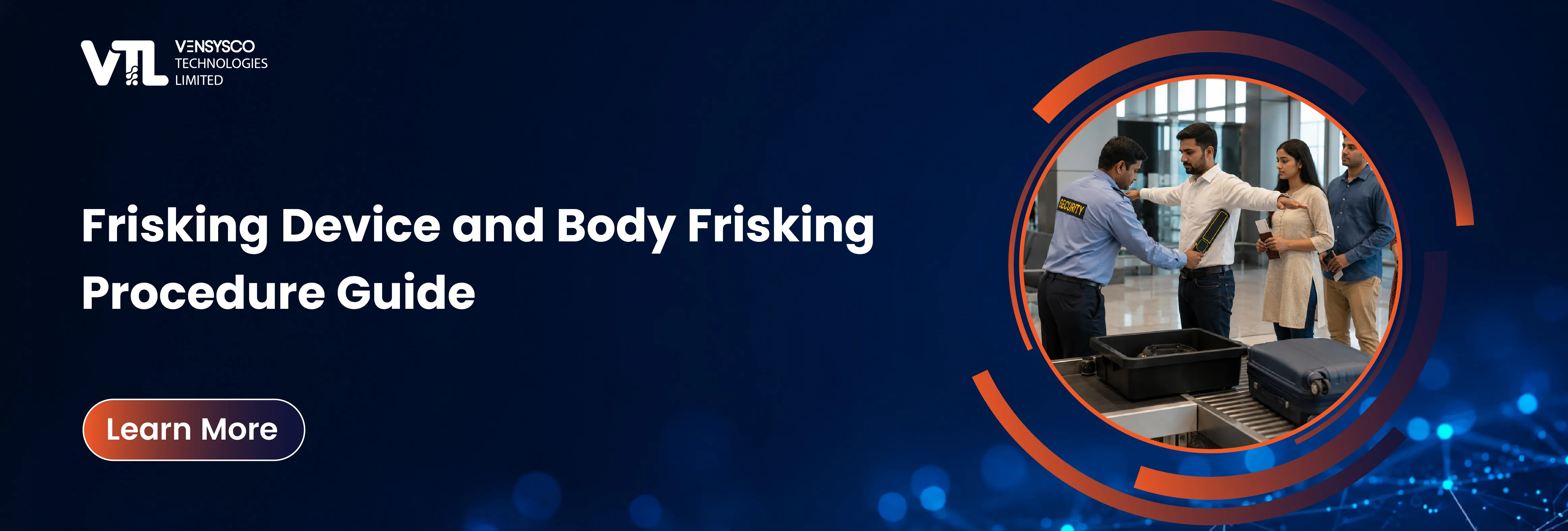
Frisking Device and Body Frisking Procedure Guide
09-01-2026
Frisking is an important aspect of overall security at the facility. The search procedure for weapons (firearms, ammunition, sharp objects, and so on) and metals as well as illegal materials and contraband is a procedure that is often conducted at airports, examination centers, office buildings, sports grounds, and governmental institutions. Frisking procedure helps create a safer environment since it helps to detect potential hazards at an early stage and prevent them from becoming bigger problems.
Importance of Frisking in Modern Security Environments
New threats have resulted in a situation where the security environment of today is becoming increasingly complex. There have been more threats recorded than ever before, but in addition to this, there are now more complex means to hide through technology and media. Defensive strategies such as the constant use of HHMDs, DFMDs, and HFMDs help to quickly conduct security checks on large numbers of individuals. The basic aim of conducting these security checks is to prevent any violation of security through timely interception of threat.
Understanding the Concept of Frisking
Frisking refers to the process of searching for someone through either physical methods or the use of specific tools to uncover any concealed objects. Frisking through HHMD involves searching for people for metallic objects without making any physical contact. This is important in the sense that there are possible dangers associated with concealed weapons or hazardous materials.
Definition of Frisking - In Simple Terms
To put it simply, frisking is a procedure whereby individuals are searched to see whether they have any weapons, contraband or any other item that is not supposed to be on their person when entering a secure area. This can be done by either doing a manual search of the individual or using a frisking machine such as an HHMD, DFMD, or HFMD.
Differences Between Frisking, Screening, and Scanning
Frisking refers to a physical search or a body scan using devices. On the other hand, screening is a more generalized process that consists of observation, interrogation, and preliminary confirmation. Scanning refers to use of sophisticated technology such as X-rays, DFMDs, or HFMDs. These terms have been used interchangeably, but their correct meaning should be distinguished.
Types of Frisking in Security Protocols
The techniques used differ from one environment to another and regarding the risk involved. Manual techniques involve searching through the physical environment carried out by professionals. Assisted techniques employ HHMD friskers, DFMD gadgets, or HFMD gadgets. The automated technique uses artificial intelligence sensors, infrared imagers, and complex algorithms. All three techniques support each other to form a formidable defense system.
Overview of Security Devices Used for Frisking
The security guards use different types of specialized equipment. Hand-held metal detectors enable the detection of any concealed metallic objects. The directed-field metal detectors placed in the entrance points can detect anybody passing through. High frequency metal detectors are widely used in areas where high security measures are needed. Baggage scanners are helpful in examining any personal luggage.
Hand-Held Metal Detector (HHMD) Explained
HHMD is a small portable instrument that can be used for locating metal objects concealed in one’s clothing. It includes the following components: a search coil, control circuitry, audio and visual alarms, and a battery pack. Suitable applications for such equipment would be airport, examination hall, public event, and corporate security checks.
Working Principle of HHMD
HHMD technology functions by sensing disruption within an electromagnetic field. With the coil of the machine emitting an electromagnetic pulse, any metallic object causes disruption within that electromagnetic field. The disruption then alerts the user via audio/visual means. It ensures accurate identification regardless of whether the metallic object is tiny or well hidden.
Advantages and Limitations of HHMD
HHMD scanners are portable, lightweight, easily manageable, and highly accurate in detection. The accuracy of HHMD scanners at short distances does not require any kind of physical contact for HHMD frisking. However, there are certain restrictions on HHMD scanners in terms of limited distance, manual operation, and high crowd throughput locations.
Door Frame Metal Detector (DFMD) Overview
DFMD is a fixed gate-like device that is set up in entryways. It allows for the continuous monitoring of crowds through the screening of people as they move past. The system uses multi-zone detection panels, control units, and threshold setting mechanisms. These devices play a critical role in mass gatherings and controlled entryway facilities.
DFMD Working Principle
DFMD technology is normally based on pulse induction technology or continuous wave technology. The former produces burst of electromagnetic energy, while the latter emits uninterrupted waves, with the return waves being analyzed in order to determine the presence of metal. Both technologies provide high speed processing and detection capabilities.
Comparing HHMD and DFMD in Security Screening
The use of HHMD and DFMD machines is quite complementary in nature. The DFMD machines handle large-scale screening operations in an effective manner, but sometimes it may be necessary to use the HHMD machines to locate the precise location of the detected objects.
Understanding HFMD in Security Operations
HFMD means High Frequency Metal Detector. The HFMD machines employ sophisticated frequency modulation in detecting hidden metals with enhanced sensitivity compared to normal detectors. They are thus ideally suited for places which require extra caution such as research laboratories, VIPs’ places, and defense establishments.
Choosing the Right Frisking Device for Your Security Setup
Selection of a frisking device is determined by several factors including crowd size, level of risk, entry point setup, personnel, and budget constraints. The DFMD gates are best for continuous streams, HHMD for targeted searches, and HFMD devices for locations that require advanced analysis capabilities.
Frisking Machine: Definition, Types, Working Principle
Frisking machine is another term used for metal detectors; however, it can also be used to refer to any assisted device that helps detect objects that are concealed by a person. Depending on the setting in which it becomes necessary to deploy frisking machines, HHMD (handheld metal detector), DFMD (door frame metal detector), and HFMD (high-frequency metal detector) can all be considered. There are several factors that determine the choice of an appropriate frisking machine.
Step-by-Step Manual Body Frisking Procedure
The common body frisking process involves four steps including observation, communication, pat down systematically, and device detection. Security personnel first conduct observation before asking the person to stand steady with hands spread out and conducting the frisking process starting from top to bottom part of the body.
Pre-Frisking Communication Guideline
Prior to conducting frisk search procedures, it is necessary for personnel to be very clear and polite. The individuals should give an explanation on what is expected from them. This will prevent any kind of panic situation from arising.
Safe and Ethical Contact Zones During Frisking
Staff are supposed to keep themselves restricted to only those permissible areas like arm, shoulders, sides of the body, legs, and feet. Areas which are sensitive need minimum contact and can be examined using an HHMD.
Special Considerations for Female Frisking Procedures
The frisking of females is required to be done by female officers in a secluded place. Furthermore, searching machines can also be employed for carrying out the process so that there is no physical contact between the female officer and the female suspect at all, but cultural norms should be adhered to where necessary.
Non-Contact Frisking Methods
Non-contact frisks do not involve physical contact with the suspect. This may be accomplished by using HHMD, HFMD or DFMD, or through observation of the suspect during the frisk, while minimizing physical contact but ensuring correct identification. Non-contact techniques are most appropriate in scenarios where physical contact may lead to confrontations and danger...
Handling High-Risk or Uncooperative Individuals
Security staff should keep their distance and give calm verbal commands. In case of continued non-cooperation, emergency measures should be initiated. The reinforcement team can step in if there is any threat.
Integrating Frisking Devices with Manual Checks
Combining human judgment with modern technology ensures stronger security. Flow of material is managed with the help of DFMD units; HHMD devices detect anomalous material locations; and the findings generated by both DFMD and HHMD are confirmed by the individual conducting the manual frisk. Combining all three systems provides a more thorough means of mitigating risk.
Common Mistakes in Frisking and How to Avoid Them
Examples of errors include inaccurate body searches, incorrect HHMD hand position, failure to calibrate the HHMD, and inadequate interaction between the user and the device. The likelihood of occurrence of these errors may be minimized through proper training, following tested procedures, and using the equipment appropriately.
Best Practices for Maintaining Frisking Equipment
Frisking equipment must be maintained through regular calibration, testing during every shift, and storing the equipment in controlled environmental conditions. Battery management is important for the HHMD; the DFMD needs to be diagnosed periodically. Regular scheduled maintenance also increases the life of the equipment, as well as its reliability when needed to perform its function.
Legal and Ethical Compliance in Frisking Procedures
Security staff must understand individual rights and permissible search boundaries. Consent, privacy, and proportionality form the basis of compliant frisking operations. Adhering to legal frameworks protects both the organization and the individual.
Training Requirements for Security Personnel
Personnel must complete specialised training in frisking techniques, device operation, behavioural analysis, de-escalation skills, and emergency response. Continuous drills and certification updates ensure high performance levels and procedural integrity.
AI-Driven Smart Frisking Machines: Advances in 2026
Technology in security screening keeps advancing. In recent frisking machines, there is AI-driven anomaly detection that highlights anomalies for closer analysis instead of just applying a predetermined sensitivity setting. Data logging helps the facility keep track of foot traffic and identify any alerts coming from the same checkpoint again, making it easier to make staffing decisions. Although manual body frisking protocols will continue to be necessary where there is an alert by the machine, this technological advancement is making it possible to screen people much more quickly.
Frisking in Government and Competitive Examinations
Security personnel check candidates and examination areas for prohibited items and weapons. To accomplish this, candidates are scanned using handheld and doorframe metal detectors located at their examination entrance. Candidates are screened for items such as cell phones, tablets, and unnecessary trash. Frisking helps to ensure that each candidate has access to identical information during the entire testing process.
Frisking ensures a safe environment for both candidates and staff, allowing every candidate to fully utilise their potential without fear of cheating. In that regard, frisking creates a disciplined environment that allows candidates to perform their assessments without any safety concerns and with confidence. Modern security companies such as Vensysco Technologies Limited (VTL) hire qualified personnel and utilise up-to-date technology when performing frisking services for examination centres. By partnering with VTL, examination centres can provide efficient crowd control, eliminate opportunities for cheating, and build confidence in the integrity of the examination process.
Conclusion
When used properly using HHMD, DFMD, and HFMD systems, frisking increases the efficiency of security systems. Frisking techniques will increase the efficiency of the security system of the facility. Efficient frisking leads to better identification of people and objects using an efficient way of managing the crowd and a safer environment. It is important that the technical guidelines, legal guidelines, and basic guidelines (professional code of conduct) must continue to be followed in the implementation of these methods.
Organisations seeking professional frisking solutions can rely on Vensysco Technologies Limited (VTL) for scalable and reliable services.
Frequently Asked Questions
What does frisking mean?
Frisking is the process of examining a person either physically or through frisking machines to establish if there are hidden weapons, restricted articles or contraband before being allowed access to a secured area.
What are the different forms of frisking?
There are three major forms of frisking including manual frisking which involves a physical search, device assisted frisking where the device uses HHMD, DFMD or HFMD, and automatic frisking where AI sensors and imaging systems are used.
What is the body frisking process?
The body frisking process starts with a visual inspection and communication, followed by a pat down from top to bottom of the body and verification of anything suspicious using a frisking machine.
Why do we need the security frisking procedure in examination centers?
Security frisking procedure in examination centers is necessary because it helps avoid bringing in restricted electronic gadgets or prohibited material in the exam hall.










Ready to secure your next examination?
Contact Vensysco today to learn how AI surveillance can safeguard your assessments.
Schedule a Demo